Aki Spadaro
musician (IT), soundcloud
- music for films
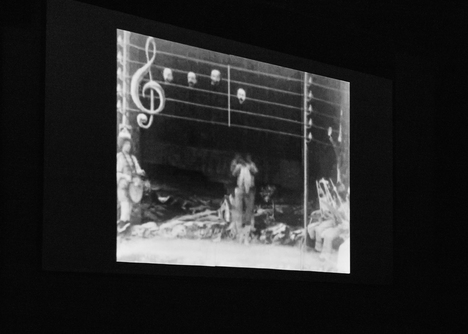
After he invites jazz pianist Aki Spadaro, a piano on wheels gets rolled on to the stage and almost tramples RJJ. Aki is calm and collected and, admittedly, quite funny (with an accent adorned with the same jazz his music's made of). He introduces us to a silent film from 1903 called ‘The Melomaniac’ by French filmmaker Georges Méliès. The film, just shy of 3 minutes, shows a man (played by Méliès) marching in (a scene) with a bunch of ladies holding batons and throwing his head up multiple times on telegraph wires. (Roughly at this point someone sitting next to me kicks and breaks a wine glass.) The man uses the batons to form notes out of the suspended heads on the wires, and eventually after they dance to the music he just composed with the heads, he sort of scamper-dances out of the frame with the ladies and his heads fly off in various directions. It is frighteningly beautiful and leaves you with a spectrum of emotions that are difficult to convey, like a very weird dream from which you wake up so confused that you have to recalibrate yourself. On his three-fold presentation's first round Aki improvises a piece of music by just looking at the film and playing what it makes him feel like; without adhering to any expectations, he composes a score that is, well, simply beautiful. On the second round Aki plays a soundtrack that is bound to fit the dynamics of the film: joyful as they start dancing, nervous as Méliès tries to figure out –for a mere second -- how to haul the huge treble clef up on the telegraph lines. Finally we watch the film in silence; the room is mute like a fishtank but suddenly I hear everything. A girl is scratching her hand somewhere in the audience; and then the lights come on, and the applause is deafening. The piano rolls out like a heavy wooden door.
Film and live music, 1903 and 2015, 3 x 2,40 min